
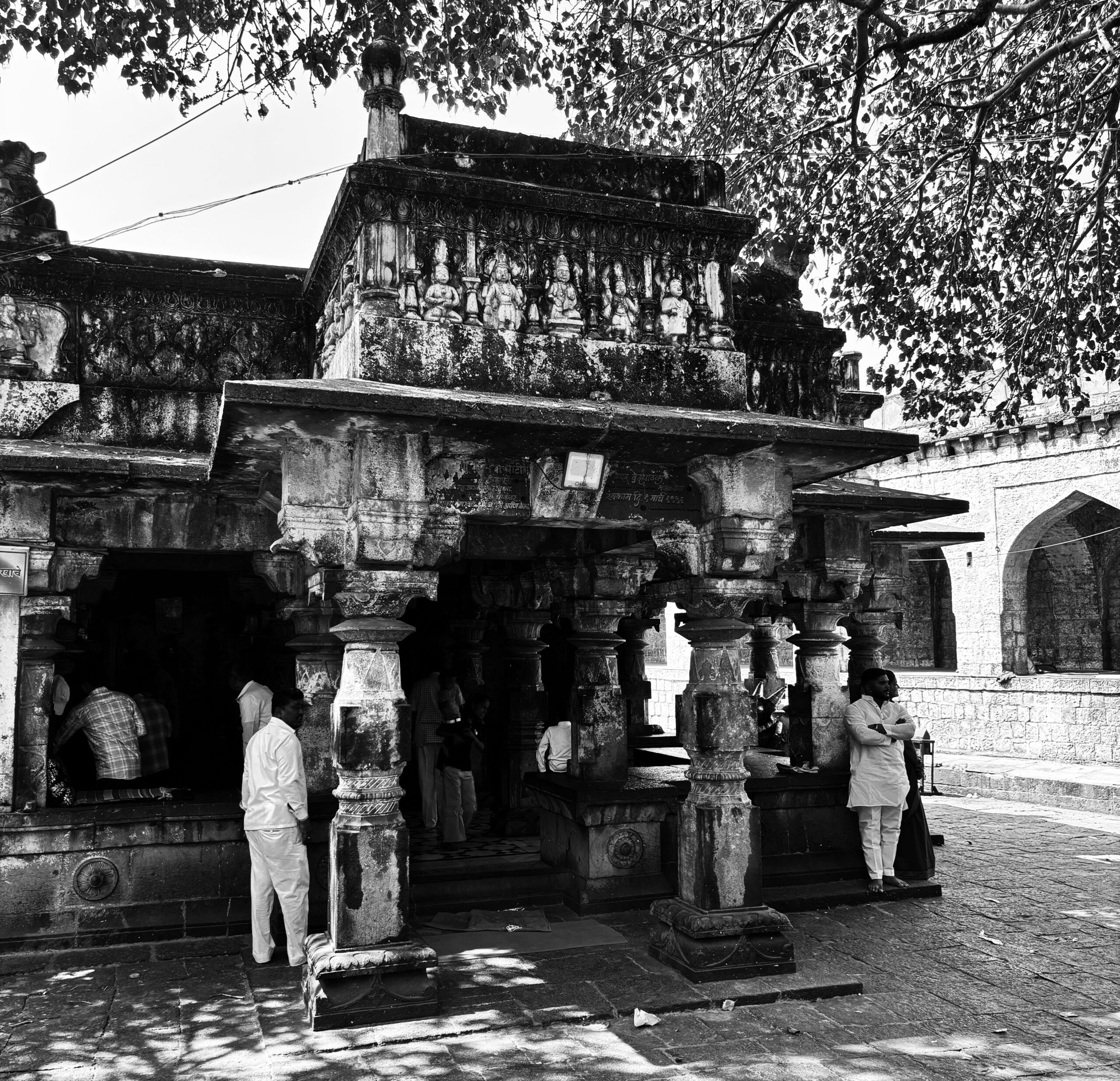
On the Solapur-Mangalvedha road, 40 km from Solapur in Mangalvedha taluka, lies Shri Kshetra Machnur on the banks of the Bhima River. This sacred place houses the ancient temple of Siddheshwar, along with the Jatashankar temple situated within the riverbed. upon entering Machnur village, the first structure one encounters is the Siddheshwar temple. Built of black stone, its architectural style bears a certain resemblance to that of the Tuljapur temple. Passing through the stone gateway, one finds guard chambers on either side, while on the left are stone-built rest sheds (ovari) for pilgrims. In front of these owaras, to the left of the descending stone steps, stands the Mallikarjuna temple. These broad steps lead down to a second gateway. In the walls of this gateway are two virga’ (hero stones) set on either side. Standing in the entrance, one can view the entire temple complex. The Siddheshwar temple, a medieval construction, is surrounded by stone fort-like walls. Within this enclosure, owaras are built on all four sides to provide lodging for devotees. Staircases within these owaras allow access to the top of the ramparts. Massive stones were used in the construction of these walls and buildings. Outside the temple stands an ancient peepal tree with a stone platform (par) at its base. Facing the temple is a magnificent three-foot- tall Nandi idol, while inside the sanctum is the Linga of Siddheshwar adorned with an ornate silver mask. The temple layout follows the traditional structure: Garbhagriha (sanctum), Sabhamandap (assembly hall), and mukha-mandapa (entrance hall). To reach the sanctum, two doorways must be crossed — the first about five feet high, the second just two and a half feet high. On the right side of the temple, a door in the fort wall opens toward the river, revealing a broad and beautiful Chat (bathing steps). On the parapet of this Chat, carvings of tigers can be observed upon close inspection. This Chat is believed to have been built by Ahilyabai Holkar, the devout Maratha queen.
Above the Chat lies the Mokshadham Ashram, and descending some 20—25 steps further leads to a small temple of Jatashankar situated in the middle of the riverbed. This shrine is accessible by boat. It is said that the spire of the Jatashankar temple was washed away during the devastating floods of the Bhima River in 1956. Traces suggest that in earlier times, there was a large settlement outside the fort-like enclosure of the Siddheshwar temple, and evidence indicates that more temples might have existed in the surrounding area. The temple hosts a grand fair during Mahashivratri, attracting numerous devotees. Priests from Pandharpur, known as Badwe, also come here during the holy month of Shravan to perform worship. The Siddheshwar temple is undoubtedly ancient, though its exact date of construction is unknown. However, it is believed to have existed before the Mughal emperor Aurangzeb, as he camped at Machnur fort (near the temple) between 1694 and 1701. During his stay, Aurangzeb attempted to destroy the temple. Local tradition narrates an interesting legend about how Machnur got its name: After conquering this region, Aurangzeb ordered his soldiers to destroy the Shivalinga at Siddheshwar. But as the soldiers approached, they were attacked by swarms of bees and hornets, forcing them to retreat. Furious, Aurangzeb then sent beef as an offering to desecrate the shrine. However, when the offering was placed before the Linga and the cloth covering was removed, it had miraculously transformed into white flowers. Seeing that the meat (Maas) had changed its appearance (Noor), the place came to be called “Maas-Noor”, which eventually evolved into Machnur. Shamed by this divine intervention, Aurangzeb compensated the temple by granting it two annual stipends — one of 400 and another of Even today, the temple continues to receive 480 as annual revenue (varshasan) from the Government of Maharashtra.